If you have PCOS, you already know how confusing it gets. One article tells you to eat more protein. Another says go low-carb. Your neighbour swears by some diet her cousin followed. And somewhere in between all of this, you’re just trying to figure out what to eat for lunch.
I’ve spoken to women managing PCOS across India, and the one thing that comes up again and again is this – nobody is talking about Indian food specifically. Most guides are built around avocados and quinoa. Not dal and roti.
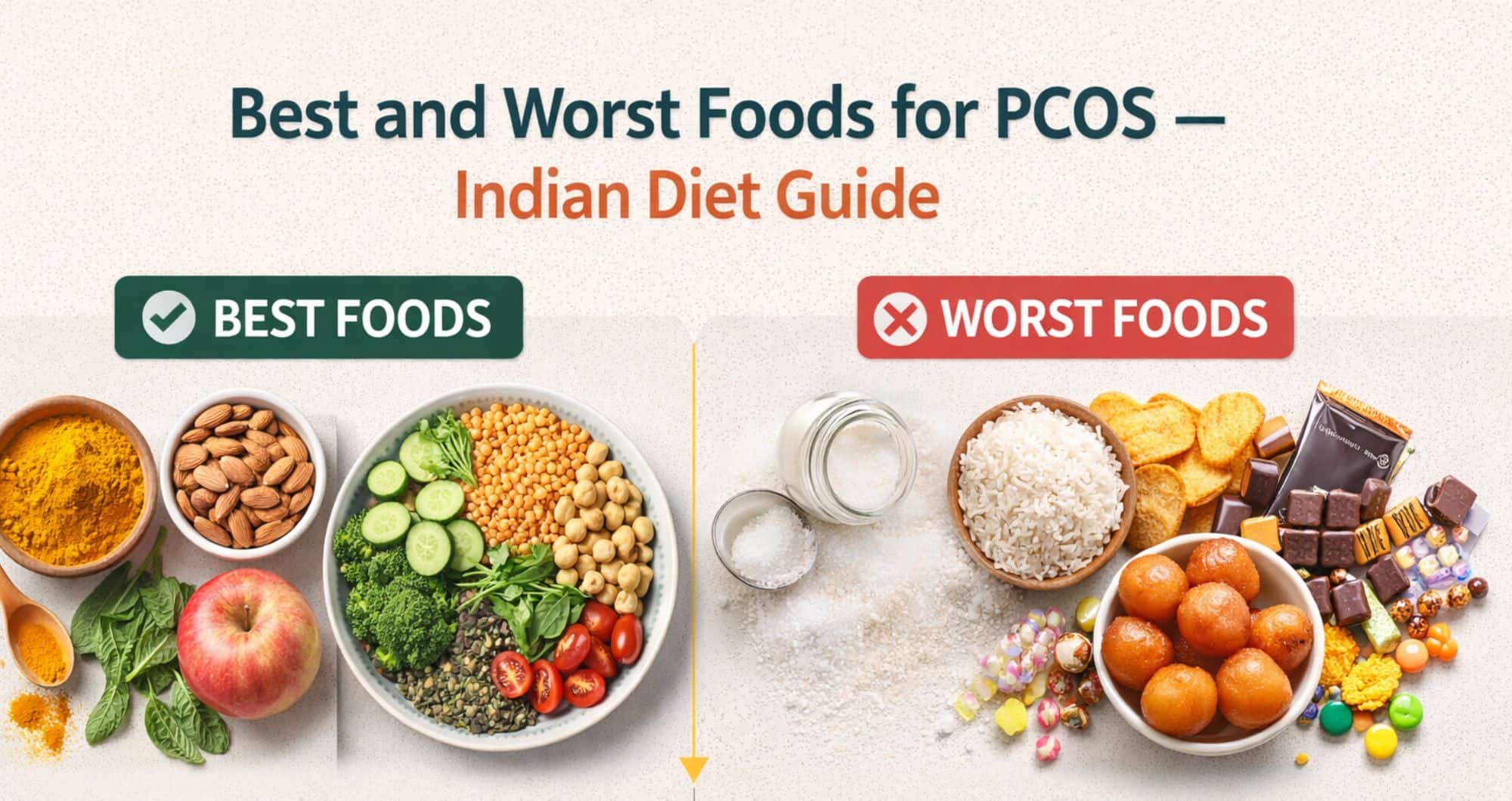
This guide focuses on the best and worst foods for PCOS using everyday Indian food, so you can make practical, sustainable changes.
So let’s fix that.
What PCOS Actually Does to Your Body
PCOS sounds complicated. Once you break it down, it starts to make sense.
It’s a hormonal issue.
But there’s something deeper going on for many women insulin resistance.
Here’s what that means in real life.
Your body eats food.
That food turns into sugar in your blood.
Insulin is supposed to help move that sugar into your cells.
But with PCOS, your body doesn’t respond properly.
So what happens?
- Your body makes more insulin
- That extra insulin messes with your hormones
- Your ovaries start producing more male hormones
And then things slowly start showing up.
- Periods become irregular
- Weight starts increasing, especially around the belly
- Acne doesn’t go away easily
- Hair fall or unwanted hair growth begins
It doesn’t all happen overnight.
But it builds up.
Now think about this.
If insulin is already a problem…
and your daily food keeps increasing it…
are you helping your body or making it harder for it?
That’s where food becomes important.
Not in a strict “diet culture” way.
But in a very practical, everyday way.
- What you eat affects your blood sugar
- Blood sugar affects insulin
- Insulin affects your hormones
It’s all connected with each other.
Because it’s not just about eating less. It’s about eating right for your body.
Small changes, done consistently, can shift things more than extreme diets ever will.
Best Foods for PCOS – The Indian Kitchen Has More Than You Think
Here’s the good news. Indian food, when put together well, is actually great for PCOS. The problem is the way we sometimes eat it — too much rice, deep-fried snacks, sugar-heavy sweets. But the base ingredients? Solid.
1. Lentils and Legumes (Dal, Rajma, Chana)
If there’s one thing I rarely ask my PCOS clients to remove, it’s dal.
These are simple foods. But they work really well for your body.
They give you protein.
They have fiber.
And they don’t spike your blood sugar the way refined carbs do.
Here’s how you can include them:
- Masoor dal, moong dal, and chana dal are all easy, everyday options
- Rajma and chole are more filling, so they’re great when you feel extra hungry
- They help keep your blood sugar steady after meals, which supports better insulin balance
Nothing complicated here.
If dal is already a part of your daily meals, you’re honestly on the right track. You don’t need to replace it with something fancy.
Just keep it consistent.
2. Whole Grains Over Refined Ones
This is where a lot of women with PCOS go wrong without realising it. White rice and maida break down fast and spike blood sugar quickly.
Switch or reduce:
- White rice – try smaller portions with a lot of vegetables and dal
- Maida rotis – shift to whole wheat or jowar or bajra rotis
- White bread – just cut it out if you can
Jowar, bajra, and ragi rotis are honestly underrated. They’re low glycaemic, filling, and most people in South and West India grow up eating them anyway.
3. Non-Starchy Vegetables
Most of us treat vegetables like a side thing on the plate.
But for PCOS, they should take up real space in your meal.
These are low in calories, high in fiber, and they help your body manage insulin better.
Simple options you already have at home:
- Palak, methi, lauki, tinda, turai, bhindi — all solid choices
- Methi is especially helpful. It supports better insulin response
- Cauliflower and cabbage are also great. They help your body handle estrogen more efficiently
Nothing fancy again.
Just regular sabzi, cooked at home.
Try this — instead of making roti or rice the main focus, shift your plate.
Let sabzi take the lead.
It sounds like a small change, but it actually makes a big difference over time.
4. Healthy Fats – Ghee, Coconut, Nuts
- A small amount of ghee with your roti or dal can actually help slow the rate at which glucose enters your bloodstream. Just keep the quantity in check. A little works. Too much doesn’t help.
- A handful of almonds, walnuts, or pumpkin seeds as a snack is much better than biscuits. Coconut used in South Indian cooking — coconut chutney, coconut in curries — provides medium-chain fats that the body handles well
- Avoid refined vegetable oils in large quantities; cold-pressed oils are better
5. Anti-Inflammatory Spices
This might sound surprising, but your regular masala dabba is doing more for you than you think.
You don’t always need fancy supplements.
A lot of what your body needs is already sitting in your kitchen.
If you’re using these regularly, you’re already only supporting your hormones.
Here’s what I usually point out:
- Haldi is great for reducing inflammation and supporting liver health
- Dalchini can help improve how your body responds to insulin
- Methi seeds, when soaked overnight, can be a good addition to your morning routine
- Jeera supports digestion and helps with blood sugar balance
Nothing complicated here.
You don’t need to start anything extreme.
Just be consistent with your cooking.
Use these spices regularly, not occasionally.
That’s where the real benefit comes in.
6. Protein at Every Meal
PCOS and low protein are a bad combination. Protein slows digestion, keeps you fuller, and helps stabilise hormones.
- Eggs are a great option if you eat them
- Paneer in moderate amounts
- Curd and buttermilk — also good for gut health
- Dal and legumes count here too
A lot of Indian women eat very carb-heavy meals. Two rotis and some sabzi with barely any protein. That pattern doesn’t work well for PCOS.
Worst Foods for PCOS – The Ones Worth Cutting Back On
Now the harder part. Some things that are very common in Indian eating habits are genuinely not great for PCOS.
1. Refined Carbs and Maida-Based Foods
Maida is everywhere. Bread, naan, samosas, pav, biscuits, cakes, puri.
All of these spike insulin fast. And for someone with PCOS and insulin resistance, that spike happens more dramatically and takes longer to come down.
This doesn’t mean never eating a puri in your life. But if you’re eating these things daily, that’s worth changing.
2. Sugary Drinks and Packaged Juices
This one is sneaky because people think fruit juice is healthy.
- A glass of packaged mango juice can have 25+ grams of sugar
- Cold drinks, energy drinks, even “health” drinks like certain flavoured milk brands
- Chai with 3 spoons of sugar, three times a day, that adds up
If you’re managing PCOS, liquid sugar is one of the first things to address. Water, plain chaas, herbal teas, and coconut water (in moderation) are better choices.
3. Dairy in Large Quantities
This one isn’t black and white.
Some women with PCOS handle dairy just fine.
Others notice things getting worse.
For some, too much dairy can trigger:
- More acne
- Bloating
- Hormonal flare-ups
Especially when it’s consumed daily in larger amounts — milk, paneer, cheese, all together. There’s also some evidence that full-fat dairy may affect androgen levels in certain cases.
So what should you do?
Instead of blindly cutting it out, just observe your body.
- Are your symptoms not improving despite eating well?
- Are you having dairy multiple times a day?
If yes, try reducing it for a couple of weeks and see how you feel. You don’t need to remove it forever. Also, not all dairy behaves the same.
- Curd and buttermilk are usually easier to digest
- Milk, especially in excess, can be more triggering for some
So it’s less about “good or bad” and more about “what works for you.” Pay attention. Your body usually gives clear signals.
4. Fried Snacks
Samosas, pakoras, namkeen, mixture, chakli these are high in refined carbs, low in nutrition, and they hit blood sugar hard.
The combination of maida plus deep-frying plus salt is particularly problematic if you have PCOS-related inflammation or insulin resistance.
This doesn’t mean zero indulgence ever. But having these as your daily 4 PM snack is something to rethink.
5. Processed and Packaged Foods
Instant noodles, chips, packaged biscuits, ready-to-eat meals.
These are usually high in refined carbs, seed oils, added sugar, and preservatives. None of that is helpful for hormones.
Read the ingredient list. If sugar shows up in the first three ingredients, put it back.
6. Excess White Rice
Rice is a staple across large parts of India, especially in South India, Bengal, and Odisha. Cutting it out completely isn’t realistic or necessary for most people.
But eating a large amount of plain white rice at every meal, with minimal protein or fat, is a pattern that doesn’t work well for PCOS.
Some ways to manage this:
- Eat smaller portions of rice alongside more dal, sabzi, and curd
- Try partly replacing white rice with millets occasionally
- Cooling cooked rice before eating (and reheating) increases resistant starch, which is better for blood sugar
A Day of Eating for PCOS — Simple Indian Meal Ideas
Here’s what a decent PCOS-friendly day of eating might look like:
Morning
- Soaked methi seeds with water (first thing)
- 2 eggs or a bowl of moong dal chilla with chutney
- Black tea or green tea with minimal sugar
Mid-morning
- A small handful of walnuts or almonds
- Or a fruit like guava, pear, or apple (lower glycaemic than banana or mango)
Lunch
- 1–2 small portions of rice or 1–2 bajra/jowar rotis
- Dal (any kind)
- 1–2 sabzis including one leafy green
- Small bowl of curd
Evening Snack
- Roasted chana or makhana
- Or a small bowl of sprouts chaat
Dinner
- Light dal and vegetable soup, or khichdi with vegetables
- Or roti with paneer and sabzi
- Keep it smaller than lunch
This is not a diet plan. It’s just an example of how normal Indian food can be structured in a way that actually supports PCOS management.
Why Seeing a PCOS Nutritionist Matters
You can read a hundred articles (including this one) and still feel stuck. PCOS nutritionist doesn’t give you a generic sheet of dos and don’ts. They look at your blood reports, your lifestyle, what you actually eat, and build something that works for you specifically.
If you’re in Bangalore, you have access to some of the country’s best nutritionists. Looking for the best nutritionist in Bangalore who specialises in PCOS is worth the effort. Someone who understands regional Indian food patterns, local food availability, and can give practical advice, not just textbook recommendations.
The right nutritionist can help you understand which PCOS type you likely have, what your blood markers mean, and how to eat in a way that addresses your specific symptoms.
What the Research Actually Says
This isn’t just opinion. There’s solid evidence behind a lot of these food choices.
- A low glycaemic diet has been shown in multiple studies to reduce testosterone levels and improve menstrual regularity in women with PCOS
- Fibre intake is linked to lower insulin resistance
- Cinnamon supplementation has shown modest improvements in insulin sensitivity in PCOS patients in clinical trials
- A 2021 study published in Nutrients found that women with PCOS on a Mediterranean-style diet (which overlaps a lot with a well-structured Indian diet) had better hormonal profiles after 12 weeks
None of this means food alone cures PCOS. But it does mean food is a real, evidence-based part of managing it.
FAQs
What are the best foods for PCOS?
Protein-rich foods, fiber-heavy vegetables, healthy fats, and low glycemic carbs work best.
Think eggs, dal, paneer, veggies, millets.
Can I eat rice with PCOS?
Yes. But control portion and choose better versions like brown rice.
Is dairy bad for PCOS?
Not always. Some people tolerate it well. Others don’t.
Pay attention to your body.
How long does diet take to show results in PCOS?
You may notice small changes in 2–4 weeks. Hormonal balance takes longer. Consistency matters more than speed.
Do I need to completely avoid sugar?
No. But reduce it significantly.
Daily sugar intake will keep your symptoms active.
What’s the Best Snack for PCOS?
I get this question a lot.
And honestly, there’s no one “perfect” snack.
But there are a few options that work really well for most people.
Things that keep you full.
Don’t spike your sugar.
And are easy to stick to.
Here’s what I usually suggest:
- Roasted chana
- A small handful of mixed nuts
- Makhana
- Sprouts chaat
- Curd with a bit of flaxseeds
Nothing fancy. Just simple food that does its job.
Most of the time, the problem isn’t snacks.
It’s what we reach for when we’re hungry and tired.
Biscuits. Namkeen. Something quick.
That’s where things start going off track.
Managing PCOS through food isn’t about being perfect.
It’s about what you do most days.
Your regular ghar ka khana — dal, sabzi, roti — is already helping more than you think.
You don’t need a full diet overhaul.
Just a few shifts:
- Add more protein where you can
- Cut down on maida
- Reduce liquid sugar like juices and soft drinks
Do this consistently, and you’ll start noticing changes.
Not overnight. But slowly, in a way that actually lasts.
Because sometimes, you don’t need more information.
You just need the right direction.